Pickup bars, ties, and repeats in Guitar Pro explained
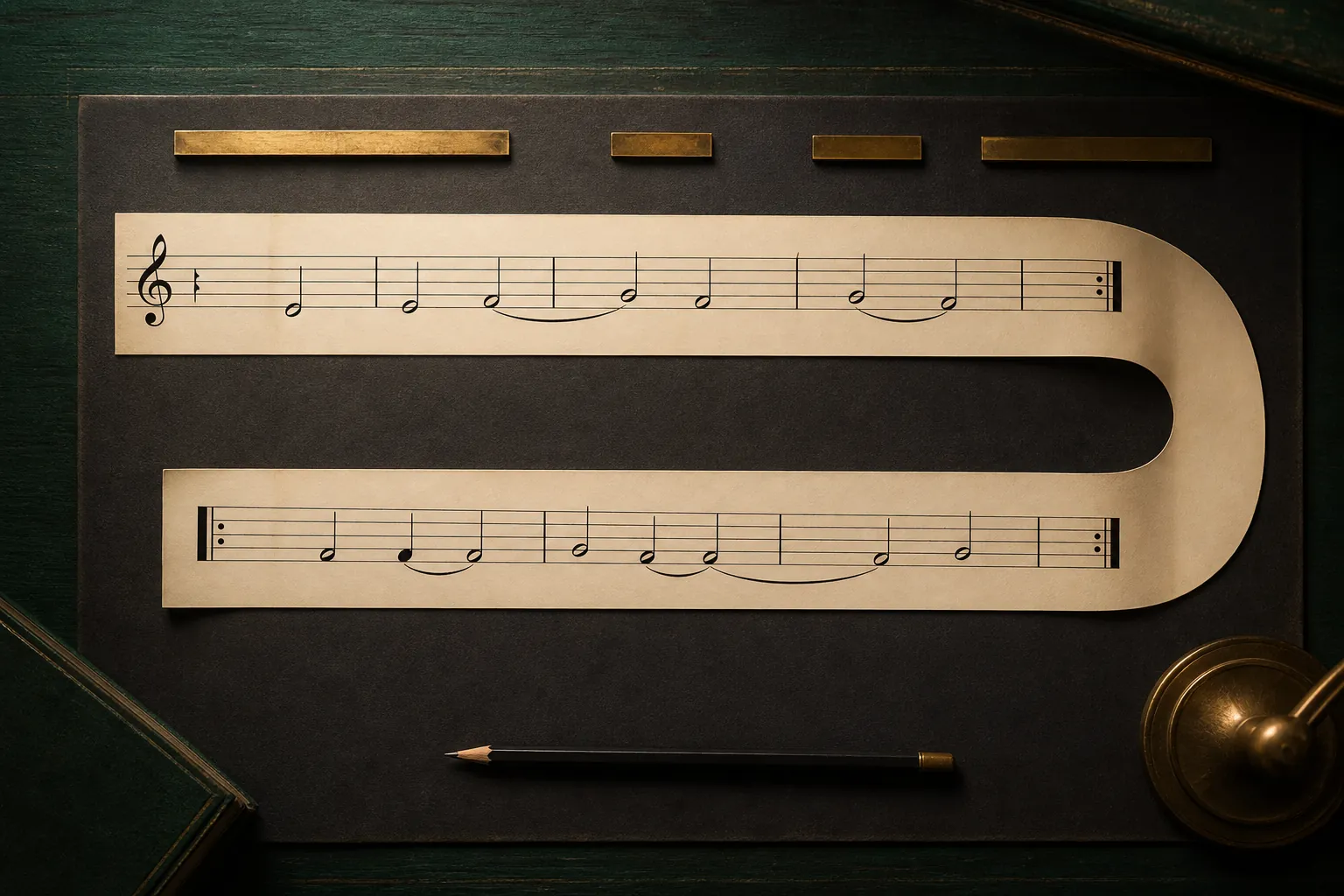
Pickup bars, ties, and repeats all affect time, but in different ways. A pickup is a deliberately incomplete opening measure, a tie combines the duration of equal pitches, and a repeat changes playback order without duplicating notation. Confusing them often produces red bars, extra attacks, or a second ending that plays at the wrong time.
The practical answer
Model the musical timeline explicitly: write the pickup as a pickup, tie only identical pitches across durations, and test every repeat path from before the opening sign through all endings.
Recognise a genuine pickup measure
A pickup, or anacrusis, contains one or more notes before the first complete downbeat. Its duration is intentionally shorter than the stated metre. The final bar may complement it in traditional notation, but the essential point is that the opening partial measure represents real musical time, not missing rests.
Do not label an arbitrary incomplete bar as a pickup just to remove a warning. Only the deliberate lead-in should be treated that way. Later underfilled or overfilled bars usually indicate wrong note values, tuplets, voices, or time signatures and should be repaired at their source.
Use ties for duration, not movement
A tie connects two notes of the same pitch so they sound as one sustained event across a beat, barline, or notational division. The second note extends duration and should not be attacked again. This is especially useful when a note crosses a barline or must show the internal beat structure clearly.
A slur, hammer-on, pull-off, or slide connects different pitches for phrasing or technique. Replacing those with a tie is musically wrong even if playback appears smooth. If a tie fails, confirm both notes have the same sounding pitch after tuning, capo, and transposition.
Build repeats as a complete route
A repeat close sends playback to the relevant repeat opening and may carry a repeat count. If there is no explicit opening where expected, software and readers must infer a starting point. Place the boundaries around the exact passage and avoid nested or overlapping structures unless the musical form truly requires them.
Test from at least one bar before the repeat opening. Watch the cursor through the close, return, and eventual exit. Starting playback inside the repeated passage may not reproduce the same state as arriving there naturally, especially when endings or directions depend on pass count.
Make alternate endings match each pass
First and second endings tell the performer which bars belong to specific passes through a repeat. The first ending must lead to the repeat close when another pass is required; the later ending must provide the route onward. Label each ending for the intended pass and ensure its bracket covers the complete bars.
For more than two passes, decide exactly which repeat numbers use each ending. Listen through the entire structure rather than clicking directly into the final ending. If playback skips or loops unexpectedly, inspect the ending assignments, repeat count, and placement of the close sign together.
Troubleshoot timing and playback systematically
When a bar turns red or the duration checker flags it, inspect every voice and the current time signature. Hidden second-voice rests, an untied duplicate attack, a tuplet with the wrong ratio, or a time-signature change placed one bar late can all create a mismatch that looks unrelated to the visible notes.
When repeat playback is wrong, simplify the diagnosis: temporarily mute unrelated tracks, begin before the repeat, and write down the actual cursor route. Check open sign, close sign, count, endings, and later directions in order. Avoid duplicating bars until the route works, because duplication can hide the structural mistake while making later edits harder.
Common questions
Sources and review notes
Product details were checked against the official sources below on 9 August 2026. Offers and software details can change, so confirm current terms before buying.